EFCI Webinar “Corporate Sustainability Reporting: From Policy to Practice” Brings Together the European Commission and Industry Leaders
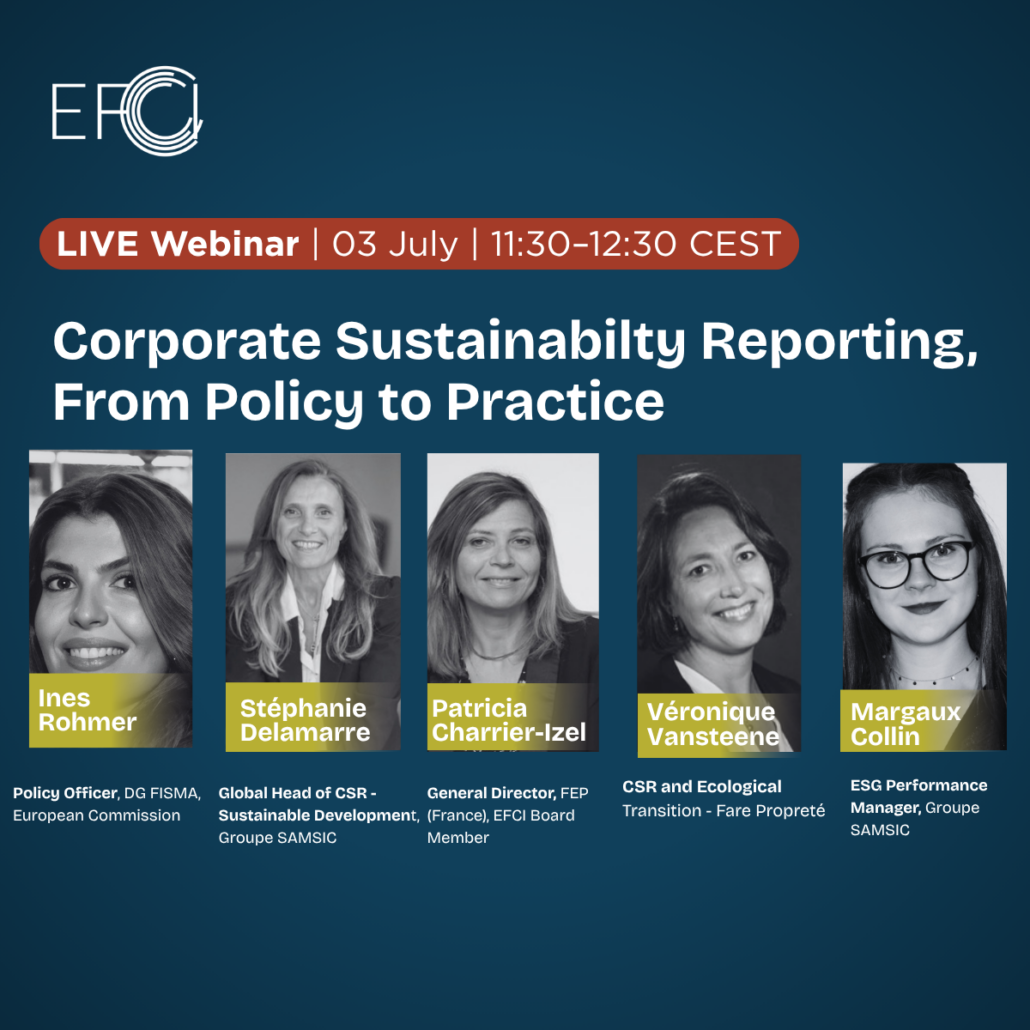
On 3 July 2026, EFCI hosted its webinar “CSRD: From Policy to Practice”, bringing together representatives from the European Commission, cleaning and facility industry leaders and national associations to discuss the latest policy developments regarding EU Corporate Sustainability Reporting and its practical implementation.
The event offered participants a unique opportunity to hear directly from policymakers and practitioners about how the EU corporate sustainability reporting framework is evolving and what it means for cleaning and facility services companies across Europe.
European Commission presents latest CSR framework developments
A highlight of the webinar was the participation of Ines Rohmer, Policy Officer in charge of Corporate Reporting from the European Commission’s Directorate-General for Financial Stability, Financial Services and Capital Markets Union (DG FISMA), who provided an overview of the latest regulatory changes introduced through the Omnibus package and the revision of the European Sustainability Reporting Standards (ESRS).
In a significant announcement, Ms Rohmer informed webinar participants that the revised ESRS had been formally adopted by the European Commission on the very morning of the webinar, making EFCI members among the first stakeholders to receive this update directly from the Commission. She also confirmed the adoption of the voluntary sustainability reporting standard designed for companies outside the CSRD scope, providing important clarification on future reporting expectations for SMEs.
The Commission presentation outlined the key changes resulting from the Omnibus simplification package, including:
- A significant reduction in the number of companies falling within the mandatory CSRD reporting scope;
- The introduction of stronger protections for smaller companies through the value chain cap;
- The simplification of reporting requirements and reduction of data points under the revised ESRS;
- The decision not to introduce mandatory sector-specific reporting standards, while preserving the European Commission’s ability to develop sector-specific guidelines upon request from industry stakeholders;
- Continued support for voluntary sustainability reporting by SMEs.
From regulation to implementation
To complement the policy perspective, participants heard practical insights from Stéphanie Delamarre, Global Head of Corporate Social Responsibility – Sustainable Development and Margaux Collin, ESG Performance Manager, at SAMSIC Group, one of Europe’s leading business services companies.
Stéphanie and Margaux shared SAMSIC’s experience in preparing for CSRD implementation, including the completion of a double materiality assessment, the alignment of ESG indicators with ESRS requirements, the strengthening of data governance processes, and the integration of sustainability considerations into business decision-making. They highlighted how CSRD preparation has helped reinforce collaboration across departments and accelerate the company’s broader ESG transformation strategy.
Supporting SMEs and sector-specific approaches
The webinar also featured Véronique Vansteene, CSR and Ecological Transition representative of the French Federation of Cleaning Companies (FEP), who presented the implications of the new framework for SMEs and explained how voluntary sustainability reporting standards can help smaller companies respond to increasing sustainability information requests from customers, investors and financial institutions.
Particular attention was given to the value of sector-specific guidance. Speakers highlighted the French cleaning sector’s work on a sectoral materiality guide and CSR framework, which provide companies with practical tools to identify the sustainability topics most relevant to their activities and prepare for future reporting requirements.
Key takeaways
Throughout the discussion, speakers emphasised that sustainability reporting should not be viewed merely as a compliance exercise, but as a strategic management tool capable of supporting business performance, improving decision-making and creating long-term value.
As a closing message, participants encouraged companies to remain pragmatic, focus on continuous improvement and strengthen their sustainability practices while progressively developing their reporting capabilities.
EFCI would like to thank the European Commission, SAMSIC Group, FEP and all participants for contributing to a highly insightful discussion. The webinar demonstrated the importance of ongoing dialogue between policymakers and industry stakeholders to ensure that sustainability reporting remains practical, proportionate and value-driven for the cleaning and facility services sector.